
EMI stands for Equated Monthly Instalment.
It is the amount a borrower generally pays each month toward an amortising loan.
An EMI typically includes:
- Principal
- Interest
When you take a loan, you borrow the principal amount.
The lender charges interest according to the applicable terms.
You then repay the borrowing over the agreed tenure through scheduled instalments.
RBI’s consumer guidance describes EMI as repayment comprising principal and interest.
Why Is EMI Important?
Before taking a loan, you should know how much you will have to pay each month.
For example, imagine you’re considering a loan with a ₹20,000 monthly EMI.
If your monthly income is ₹40,000 and you already have ₹15,000 in existing commitments, adding another ₹20,000 EMI may put significant pressure on your budget.
Therefore, EMI isn’t just a mathematical number.
It is also a budgeting tool.
What Determines Your EMI?
Three major variables determine the EMI for a standard reducing-balance loan:
1. Principal
This is the amount borrowed.
A larger loan generally means a larger EMI if the interest rate and tenure remain unchanged.
2. Interest Rate
A higher interest rate generally increases the EMI and total interest cost.
3. Loan Tenure
Tenure is the repayment period.
A longer tenure generally reduces the monthly EMI but increases the total interest paid over the life of the loan.
EMI Formula
For a standard reducing-balance loan, the commonly used EMI formula is:
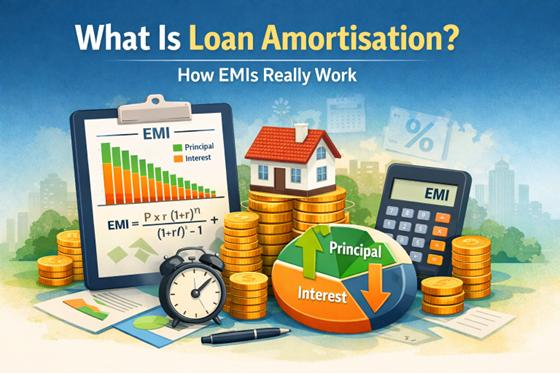
EMI = P × r × (1+r)ⁿ / [(1+r)ⁿ − 1]
Where:
- P = Principal loan amount
- r = Monthly interest rate
- n = Number of monthly instalments
If the annual interest rate is 12%, the monthly rate is:
12% ÷ 12 = 1%
Therefore:
r = 0.01
EMI Calculation Example
Let’s take:
Loan amount = ₹5,00,000
Annual interest rate = 12%
Tenure = 3 years
Convert the annual rate into a monthly rate:
12% ÷ 12 = 1% per month
Number of instalments:
3 × 12 = 36 months
Using the EMI formula, the monthly EMI is approximately:
₹16,607
So, over 36 months:
Total payments ≈ ₹5,97,857
Approximate interest paid:
₹5,97,857 − ₹5,00,000 = ₹97,857
Actual lender calculations may differ slightly due to rounding, dates, repayment conventions and product terms.
Does a Longer Tenure Reduce EMI?
Yes, generally.
Consider the same ₹5 lakh loan at 12% annual interest.
A shorter tenure means higher monthly payments but a lower total interest cost.
A longer tenure generally means lower monthly payments but more interest over the full repayment period.
This is why borrowers should not select a loan only because its EMI looks affordable.
You should also check the total amount payable.
EMI Example: Short vs Long Tenure
Imagine a ₹5 lakh loan.
Shorter Tenure
You pay a higher EMI.
But the loan is finished sooner and generally accumulates less interest.
Longer Tenure
Your monthly EMI becomes easier to manage.
But you remain in debt longer and generally pay more total interest.
Therefore:
Lower EMI does not necessarily mean cheaper loan.
This is one of the most important things borrowers should understand.
Principal vs Interest in EMI
Suppose your EMI is ₹16,607.
That entire amount doesn’t necessarily reduce your principal by ₹16,607.
Part of the EMI goes toward interest.
The remainder reduces the outstanding principal.
As the principal decreases, the interest component generally decreases over time under a standard reducing-balance structure.
That’s why your loan statement may show different principal and interest portions across different months.
What Is a Reducing Balance?
In a reducing-balance loan, interest is calculated on the outstanding principal according to the lender’s method.
For example:
Initial principal:
₹5,00,000
After several repayments, suppose the outstanding principal becomes:
₹4,00,000
Interest calculation then applies to the relevant outstanding amount under the loan’s terms rather than the original principal for every month.
This is different from some other methods of calculating interest, so borrowers should always understand the method stated in their loan agreement.
EMI and Credit Score
Your EMI also matters for your credit history.
If you consistently pay your EMIs on time, you demonstrate responsible repayment behaviour.
If you repeatedly miss payments, your credit profile can suffer.
CIBIL identifies payment history as one of the major factors affecting its score.
Therefore, before taking a loan, make sure the EMI is affordable.
How to Choose an Affordable EMI
Don’t start with:
“How much loan can I get?”
Start with:
“How much EMI can I comfortably afford?”
A simple process is:
Step 1
Calculate your monthly income.
Step 2
Calculate essential monthly expenses.
Step 3
Calculate existing EMIs and debt obligations.
Step 4
Keep money aside for emergency savings.
Step 5
Determine how much additional monthly repayment you can realistically handle.
Step 6
Use an EMI calculator to compare different loan amounts and tenures.
EMI Calculator: What Should You Enter?
A typical EMI calculator asks for:
- Loan amount
- Interest rate
- Loan tenure
For example:
Loan Amount: ₹10,00,000
Interest Rate: 10%
Tenure: 5 years
The calculator can then estimate:
- Monthly EMI
- Total interest
- Total repayment
This allows you to compare different scenarios before applying for a loan.
How to Reduce Your Total Interest Cost
You can potentially reduce the overall cost of borrowing by:
- Choosing an appropriate loan amount
- Comparing interest rates
- Selecting a suitable tenure
- Making permitted prepayments when financially sensible
- Avoiding unnecessary borrowing
- Comparing processing fees and other charges
However, check the lender’s current prepayment and foreclosure conditions before making additional payments.
Frequently Asked Questions
What does EMI stand for?
EMI means Equated Monthly Instalment.
Does a lower EMI mean a cheaper loan?
No. A longer tenure can reduce your monthly EMI but increase total interest paid.
Does EMI include interest?
Yes. For a standard amortising loan, the EMI generally contains both principal and interest.
Can EMI change?
It depends on the loan type and terms. Fixed-rate and floating-rate products can behave differently.
Is an EMI calculator accurate?
An EMI calculator provides an estimate based on the inputs you enter. The lender’s actual repayment schedule and charges should be treated as authoritative.